Part 1 of 4
Front Matter
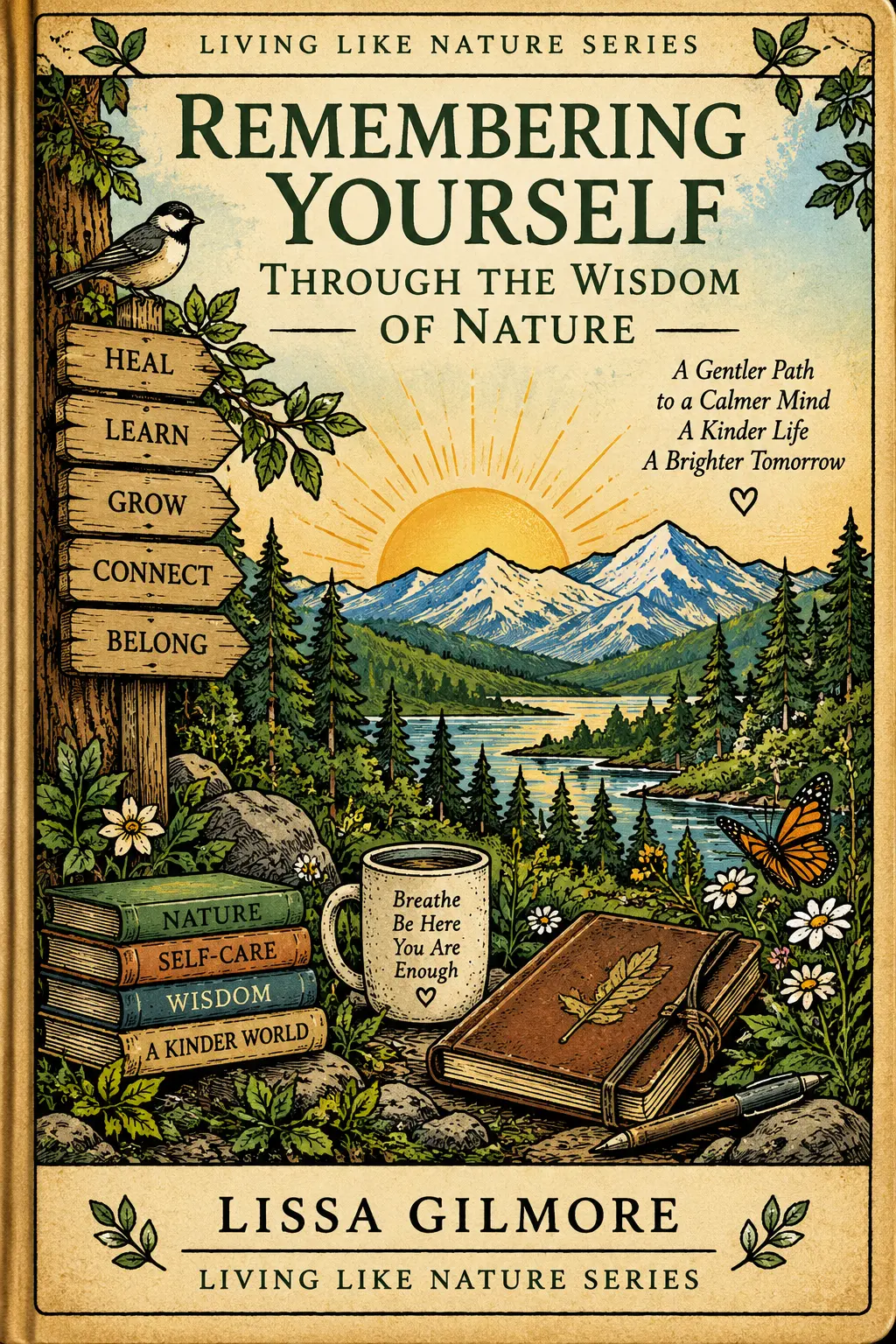
Remembering Yourself Through the Wisdom of Nature
Lissa Gilmore Living Like Nature Series
Copyright
Living Like Nature: Remembering Yourself Through the Wisdom of Nature
Copyright © 2026 Lissa Gilmore
All rights reserved.
No part of this book may be reproduced, distributed, or transmitted in any form or by any means without the prior written permission of the author, except for brief quotations used in reviews or other uses permitted by copyright law.
This book is intended for educational and informational purposes. It is not a substitute for professional medical, mental-health, legal, or other professional advice.
Living Like Nature Series
Mind Magic LLC
Dedication
For anyone who has spent so much time taking care of everyone else that somewhere along the way, they lost sight of themselves.
And for anyone beginning to remember.
A Note Before You Begin
This book isn't about becoming someone new.
It’s about noticing what may have been buried beneath expectations, responsibilities, old beliefs, and the roles you've learned to carry.
You don't need to agree with everything in these pages.
In fact, I hope you'll question some of it.
Think about your own experiences.
Notice what fits.
Look for more information when you need it.
And leave behind what doesn’t belong to you.
Nature doesn’t give us a set of instructions for how to live.
But when we pay attention, it can give us another way to look at things.
A tree adapts to the conditions around it.
A river changes course when something blocks its way.
A forest is made of different things growing together—not identical things trying to become the same.
Throughout this book, we'll use nature that way:
Not as proof, but as perspective.
You aren't here to become the person someone else thinks you should be.
You’re here to understand yourself well enough to decide what you want to carry forward.
And maybe, along the way, remember a little more of yourself.
Table of Contents
Introduction — Remembering Who You Are
Part One — Remembering
Chapter 1 — Before the World Told You Who to Be
Chapter 2 — The Moment You Realize You’ve Been Performing
Chapter 3 — The Weight of Expectations
Chapter 4 — Wanting Something Different
Part Two — Learning From Nature
Chapter 5 — The Kitten — Curiosity Before Conclusion
Chapter 6 — The Dog — Presence, Loyalty, and Connection
Chapter 7 — The Tree — Growth That Builds on What Came Before
Chapter 8 — The Forest — Growing Together Without Becoming the Same
Chapter 9 — The River — When Life Doesn't Move in a Straight Line
Chapter 10 — The Deer — Pay Attention Before You Decide
Part Three — Softening the Inner Rules
Chapter 11 — When “Should” Becomes a Rule
Chapter 12 — Self-Care — Keeping Yourself in the Equation
Chapter 13 — Rest — Knowing When to Stop and When to Start Again
Chapter 14 — Letting Go — Deciding What No Longer Needs to Come With You
Part Four — Beginning Again
Chapter 15 — Beginning Again — You Aren’t Starting From Zero
Closing Reflection — What Living Like Nature Means
A Final Thought
Introduction
Remembering Who You Are
There are times in life when you look around and realize you've become very good at being what everyone else needs.
The dependable one.
The strong one.
The caregiver.
The problem solver.
The one who keeps going.
None of those roles are necessarily bad.
Some may be parts of you that you value deeply.
The problem comes when you've spent so much time responding to life, responsibility, and other people’s needs that you haven’t stopped to ask:
What do I need?
What matters to me now?
What have I been carrying simply because I've carried it for so long?
And maybe the hardest question:
How much of the person I think I am was actually chosen by me?
We Learn From What Surrounds Us
Long before we're old enough to examine what we're being taught, we're collecting information.
From family.
School.
Friends.
Culture.
Experiences.
We learn what gets praised.
What gets criticized.
What we're expected to do.
What we're supposed to avoid.
Some of those lessons serve us well.
Others may have made sense once but don't anymore.
And some may never have been true in the first place.
That’s why remembering yourself isn't about trying to uncover some perfect, untouched version of you hidden underneath everything else.
Your experiences are part of you too.
It’s about becoming curious enough to examine what you've collected.
Does this still fit?
Do I actually believe this?
Is this something I value—or something I learned to value because someone else did?
Would I choose this again today?
You don't have to throw away your past to ask those questions.
You’re simply looking at it with the information you have now.
Nature Gives Us Another View
This is where nature enters the conversation.
Not because nature has human answers.
It doesn’t.
A tree isn't trying to teach us a lesson.
A river isn't giving us instructions.
But watching how living systems respond to change can give us another way to think about our own lives.
A tree grows differently depending on its conditions.
A river may change course when the landscape changes.
A forest contains competition, cooperation, damage, decay, regeneration, and constant adjustment.
Nature isn't always peaceful.
It isn't always gentle.
And it certainly isn't perfect.
But it is always responding.
That’s the part I'm interested in.
Examine the Rules
There are things we do simply because:
That’s how I've always done it.
That’s what my family does.
That’s what people expect from me.
I don't want to disappoint anyone.
Sometimes those are perfectly good reasons.
Sometimes they're worth questioning.
This book isn't asking you to reject everything you've learned or stop caring about the people around you.
It’s asking you to look.
To notice.
To gather information.
To decide what still belongs in your life.
And what may need to change.
This Isn’t About Becoming Selfish
When people begin thinking about their own needs, an uncomfortable question can appear:
Am I being selfish?
Maybe sometimes.
We’re all capable of that.
But having needs isn't the same thing as believing your needs are the only ones that matter.
There is room between sacrificing yourself for everyone and caring only about yourself.
That’s where many of us are trying to learn to live.
You matter.
So do the people around you.
A good decision often considers both.
You Don’t Have to Know Yet
Maybe you know exactly what you want to change.
Maybe you only know that something doesn’t feel right anymore.
Maybe you're perfectly content with parts of your life and questioning others.
You don't need to arrive at the first page with an answer.
Curiosity is enough.
As we move through this book, we'll look at the kitten, the dog, the tree, the forest, the river, and the deer—not because they hold secret instructions for human life, but because each gives us a different perspective from which to ask questions about our own.
Take what helps you see something differently.
Question what doesn’t.
And keep coming back to one simple idea:
The more you understand about what shaped you, what matters to you, and what is happening around you, the better prepared you are to choose what comes next.
Part One — Remembering
Before we decide what needs to change, it helps to understand what shaped us.
We don't begin life with a finished set of beliefs about who we are.
We collect them.
From the people around us.
From what happens to us.
From what gets encouraged, discouraged, rewarded, ignored, or repeated often enough that we stop questioning it.
Some of those lessons become useful parts of our lives.
Others deserve another look.